
Hip Instability and Hip Capsular Reconstruction
Dr. Jorge Chahla, a hip preservation surgeon at Midwest Orthopaedics at Rush, treats hip instability in athletes and active adults, most often in patients who still have pain after an earlier hip arthroscopy. Much of that instability comes from the hip capsule, the lining that covers the joint. The capsule also has an important mechanical job: it restrains certain motions of the hip.
What the hip capsule does
The hip capsule is a strong sleeve of ligaments around the ball and socket. Three ligaments do most of the work, and together they play a major role in how the hip moves and how stable it stays [1]:
- the iliofemoral ligament, also called the Y ligament of Bigelow, the strongest of the three, which limits extension and external rotation
- the pubofemoral ligament, which limits the leg moving out to the side (abduction)
- the ischiofemoral ligament, at the back, which limits internal rotation
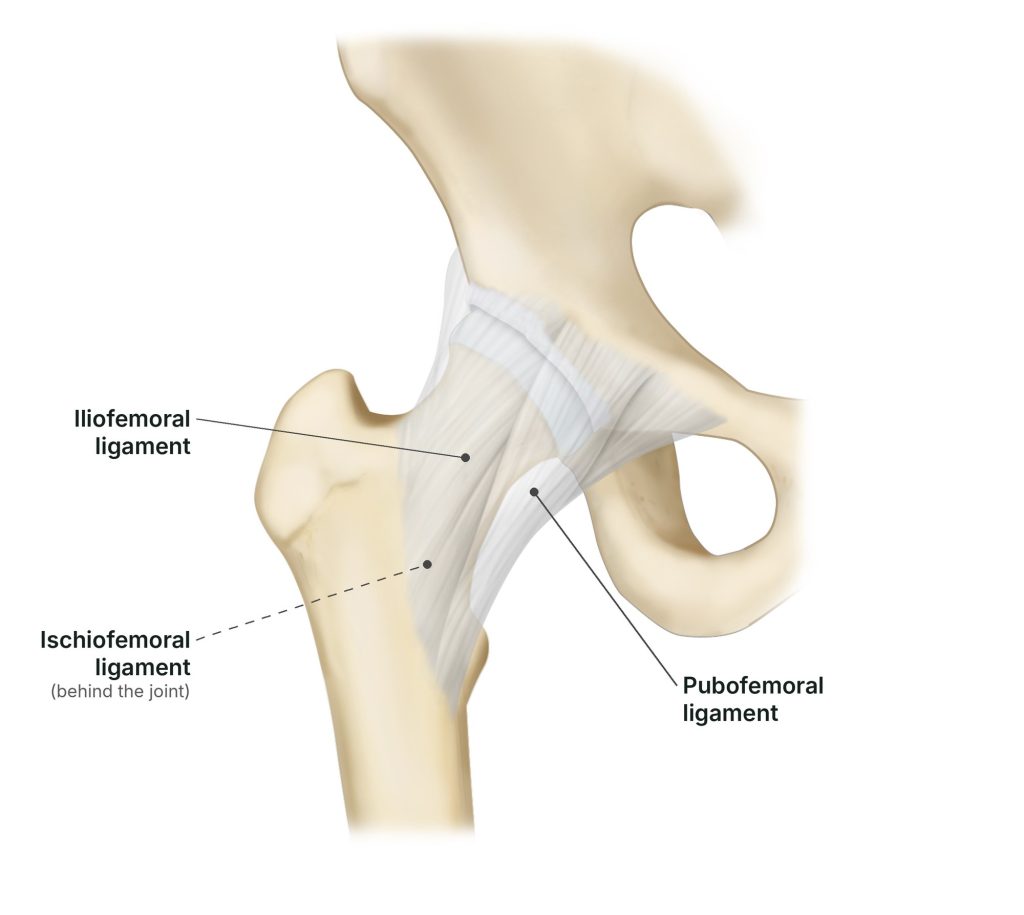
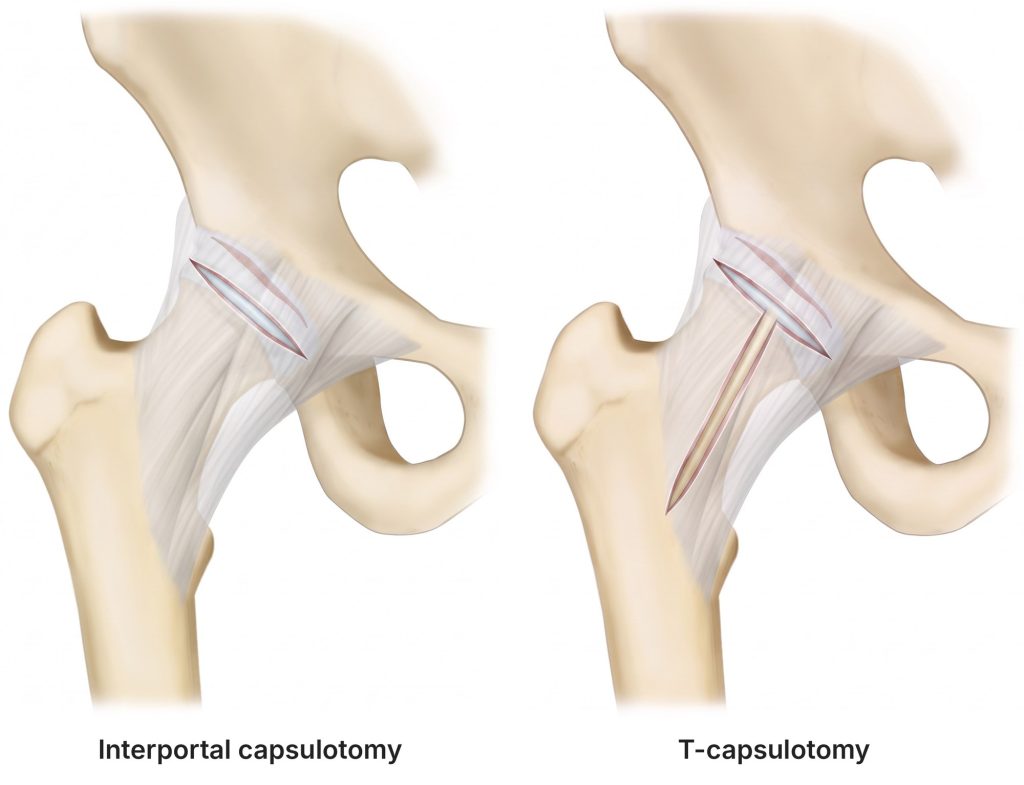
The iliofemoral ligament is the part of the capsule surgeons open to reach the inside of the hip during arthroscopy. That is why Dr. Chahla repairs it at the end of every operation.
Why closing the capsule matters
Dr. Chahla’s research group has studied the capsule closely. In a Rush study he coauthored, 97% of patients whose capsule was fully closed had not needed a revision or a hip replacement at least five years later [2]. An analysis of 11 studies and 1,897 patients that he coauthored found that full capsular closure led to better hip function in daily activities, and that patients whose capsule was left unrepaired were about 1.7 times as likely to need another hip arthroscopy and about twice as likely to need a hip replacement [3]. When the capsule is loose rather than torn, it can be tightened with stitches, a procedure called capsular plication.
Hip instability and microinstability
Hip microinstability means the ball moves slightly more than it should inside the socket. It is harder to recognize than a dislocation, and patients may go undiagnosed for a long time [4]. It can follow a capsule that did not heal after surgery, and it is more likely in people with loose joints or a shallow socket (hip dysplasia). Common symptoms include:
- deep groin pain that returns after a hip arthroscopy that first seemed to help
- a feeling that the hip slips, shifts or gives way
- pain with long strides, extension or turning the leg out
- clicking and fatigue around the hip
Who is at risk for hip instability
Hip stability depends on the shape of the bones, the labrum, the capsule and the muscles around the joint. When one of them is weak, the others have to work harder. Hip instability is more common in:
- patients who had a hip arthroscopy in which the capsule was opened and not fully closed, or did not heal
- people with ligament laxity, including connective tissue disorders such as Ehlers Danlos syndrome
- people with hip dysplasia or borderline dysplasia, where a shallow socket gives the femoral head less coverage
- dancers, gymnasts and other athletes who push the hip into extreme positions, which can cause atraumatic instability without a single injury
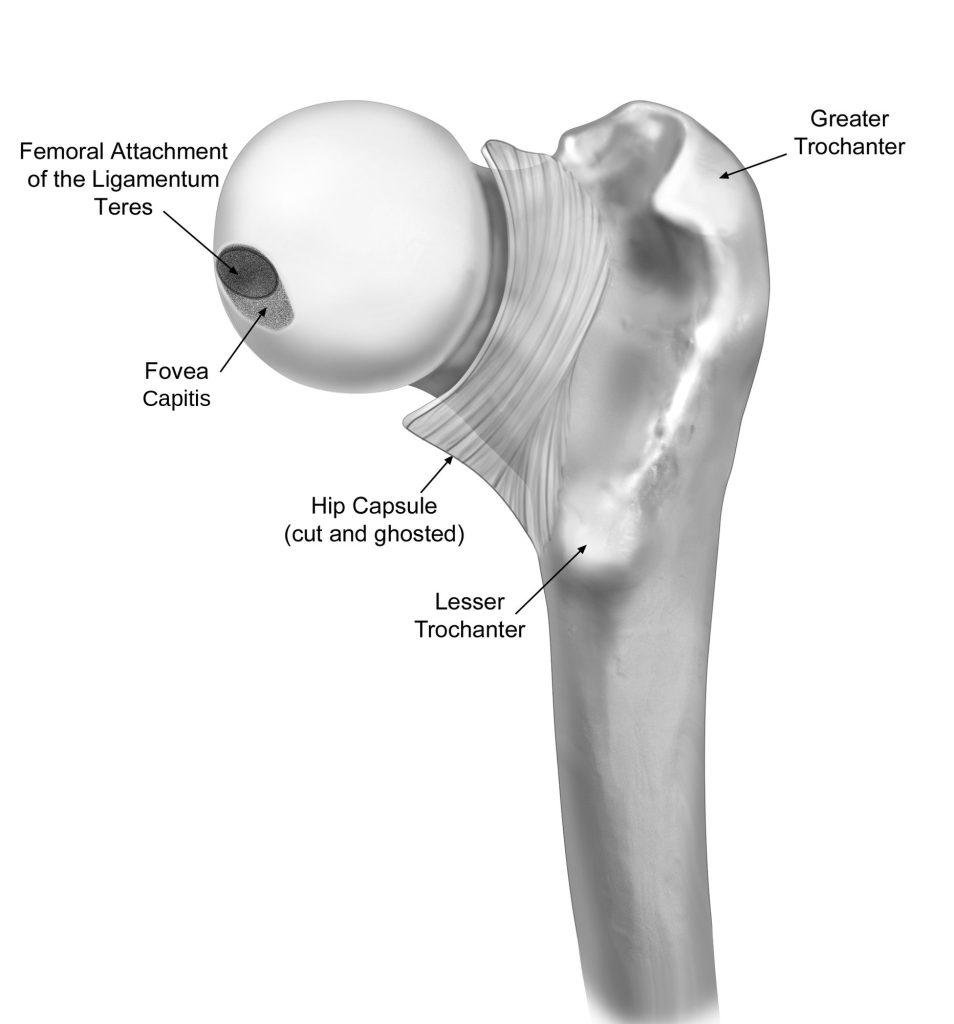
- hips with a torn ligamentum teres, the small ligament inside the joint that connects the femoral head to the socket
Instability and femoroacetabular impingement (FAI) can occur together, and over time a hip that moves too much can develop labral tears and cartilage damage.
How hip instability is diagnosed
Diagnosis starts with a careful history and physical examination. Dr. Chahla checks range of motion and uses tests that stress the front of the capsule, such as the dial test, the anterior apprehension test and the abduction extension external rotation test, to see whether the hip feels loose or reproduces the patient’s pain. An MRI, often with contrast in the joint, shows gaps or thinning in the capsule, the labrum and the ligamentum teres, and X-rays and a CT scan measure the shape of the socket and the femoral head. Treatment starts without surgery when it can, with physical therapy that builds the muscles around the hip, especially the deep hip rotators and the glutes [4].
Hip capsular reconstruction
Capsular reconstruction is a salvage procedure for a deficient capsule, most often after a previous surgery. When there is not enough healthy capsule left to repair or tighten, Dr. Chahla rebuilds it, patching the missing portion with a graft to restore the anatomy and the mechanics of the capsule.
He has published several of these techniques, including reconstruction with a dermal graft [5] and with the indirect head of the rectus femoris tendon, a strip of tendon from the front of the hip [6]. When the labrum is also deficient, the capsular reconstruction can be combined with a labral augmentation in the same operation [7]. The surgery is done arthroscopically, a minimally invasive hip preservation operation through small incisions, usually as a same day procedure. Any remaining impingement, labral tear or cartilage damage is treated at the same time, because a stable hip needs all of these structures working together. See hip labral tear treatment for how he repairs, reconstructs or augments the labrum.
Results and recovery
Revision surgery for a deficient capsule is more complex than a first hip arthroscopy, and results are more variable. In a Rush study, more than half of 90 patients having revision hip arthroscopy had a capsular defect on MRI, and two thirds of them reached a clinically meaningful improvement two years later [8]. In a larger series from another center, patients revised for capsular instability did worse than patients revised for leftover impingement, which is why careful selection and planning matter [9].
Recovery is longer than after a first hip arthroscopy, because the graft needs time to heal. Physical therapy follows a written protocol that protects the reconstruction before strength and sport are added back. See recovering from revision surgery.
Frequently asked questions
The hip capsule is the strong lining of ligaments around the hip joint. It holds the ball in the socket and limits extreme motions, especially extension and rotation.
Capsular plication tightens a loose capsule with stitches, much like taking in a shirt that has become too big. It is used when the capsule is stretched but still has enough healthy tissue.
Many patients with mild hip instability improve with physical therapy that strengthens the muscles around the hip joint. Surgery is considered when pain or the feeling of the hip giving way continues despite a full course of therapy.
Mostly patients who had hip surgery before and now have a deficient capsule that causes pain or instability, when there is not enough tissue left to repair it directly.
Request an evaluation
Dr. Chahla sees patients at Midwest Orthopaedics at Rush in Chicago, Oak Brook and Naperville, in English and Spanish, and reviews records for patients who had surgery elsewhere. Call (312) 432-2531 to schedule, or request a second opinion. Read more about revision hip arthroscopy.
Resumen en español
La cápsula de la cadera es una funda de ligamentos que rodea la articulación y le da estabilidad. Durante la artroscopia de cadera se abre para llegar al interior, y el Dr. Jorge Chahla la cierra al final de cada operación. Cuando la cápsula queda floja o no cicatriza, la cadera puede volverse inestable, con dolor en la ingle o sensación de que la cadera se desliza. Muchos pacientes mejoran con fisioterapia. Si no hay suficiente tejido para repararla, el Dr. Chahla puede reconstruir la cápsula con un injerto, por artroscopia y en general con alta el mismo día. Atiende en Chicago, Oak Brook y Naperville, y habla español. Teléfono: (312) 432-2531.
References
- Ng KCG, Jeffers JRT, Beaulé PE. Hip joint capsular anatomy, mechanics, and surgical management. J Bone Joint Surg Am. 2019;101(23):2141-2151. pubmed.ncbi.nlm.nih.gov/31800428
- Beck EC, Nwachukwu BU, Chahla J, Clapp IM, Jan K, Nho SJ. Complete capsular closure provides higher rates of clinically significant outcome improvement and higher survivorship versus partial closure after hip arthroscopy at minimum 5-year follow-up. Arthroscopy. 2021;37(6):1833-1842. pubmed.ncbi.nlm.nih.gov/33529782
- Dasari SP, Kasson LB, Condon JJ, et al. (Chahla J). Systematic review and meta-analysis of studies comparing complete capsular closure against unrepaired hip capsules during hip arthroscopy. Orthop J Sports Med. 2023;11(10):23259671231197435. pubmed.ncbi.nlm.nih.gov/37868216
- Bolia I, Chahla J, Locks R, et al. Microinstability of the hip: a previously unrecognized pathology. Muscles Ligaments Tendons J. 2016;6(3):354-360. pubmed.ncbi.nlm.nih.gov/28066740
- Chahla J, Dean CS, Soares E, Mook WR, Philippon MJ. Hip capsular reconstruction using dermal allograft. Arthrosc Tech. 2016;5(2):e365-e369. pubmed.ncbi.nlm.nih.gov/27462535
- Mameri ES, Batra AK, Kerzner B, et al. (Chahla J). Hip capsular reconstruction with indirect head of the rectus femoris tendon. Arthrosc Tech. 2023;12(4):e503-e509. pubmed.ncbi.nlm.nih.gov/37138681
- Wong S, Newhouse A, Chahla J, et al. Arthroscopic treatment of hip dislocation after previous hip arthroscopy: capsular reconstruction with labral augmentation. Arthrosc Tech. 2021;10(3):e867-e872. pubmed.ncbi.nlm.nih.gov/33738226
- Cancienne JM, Beck EC, Kunze KN, et al. (Chahla J, Nho SJ). Two-year patient-reported outcomes for patients undergoing revision hip arthroscopy with capsular incompetency. Arthroscopy. 2020;36(1):127-136. pubmed.ncbi.nlm.nih.gov/31864565
- Selley RS, Baker HP, Burger JA, et al. Revision hip arthroscopy: identifying indications and outcomes with a mean 5-year follow-up. Am J Sports Med. 2025;53(13):3207-3214. pubmed.ncbi.nlm.nih.gov/41105462
Medically reviewed by Jorge Chahla, MD, PhD. Last reviewed: November 22, 2026.
- Triple fellowship-trained sports medicine surgeon
- Board certified in orthopaedic sports medicine
- Team physician for the Chicago Bulls, White Sox and US Soccer
- Performs over 800 surgeries per year
- Associate professor of orthopedic surgery at Rush University
- Learn more