
Shoulder Surgeon and Sports Medicine Specialist in Chicago
Dr. Jorge Chahla, an orthopedic shoulder surgeon and sports medicine specialist at Midwest Orthopaedics at Rush, treats shoulder pain and a wide range of shoulder conditions, including shoulders that dislocate or feel unstable, rotator cuff tears and labral tears. As a shoulder specialist and team physician for the Chicago Bulls, the Chicago White Sox and US Soccer, he focuses on shoulder injuries in throwing, overhead and contact athletes. He provides shoulder care in Chicago, Oak Brook and Naperville.
To schedule a consultation, call (312) 432-2531 or see the office locations. Se habla español.
Shoulder dislocation and instability
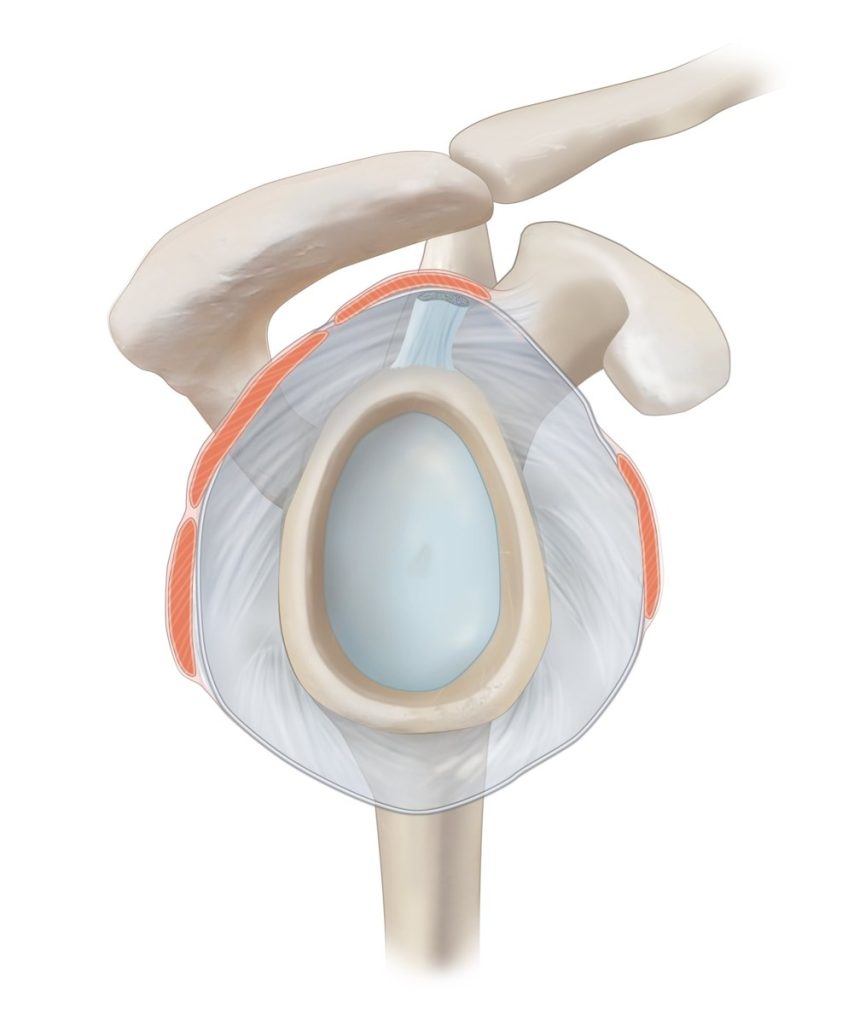
The shoulder is the body’s most mobile joint and the one that dislocates most easily. After a dislocation, especially in young athletes, the labrum and capsule that hold the ball in the socket often tear, and repeated dislocations can wear away bone from the socket (the glenoid).
Dr. Chahla checks every unstable shoulder for bone loss with a 3D CT scan, the most accurate method according to an international expert consensus he coauthored; when more than about 20% of the socket is missing, it should be rebuilt with a bone graft [1]. When bone loss is small, he performs an arthroscopic stabilization, a minimally invasive alternative to open surgery: he reattaches the torn labrum to the socket rim and tightens the stretched capsule to stabilize the shoulder joint. Bone graft procedures such as the Latarjet are coordinated with the Midwest Orthopaedics at Rush shoulder service.
Rotator cuff tears
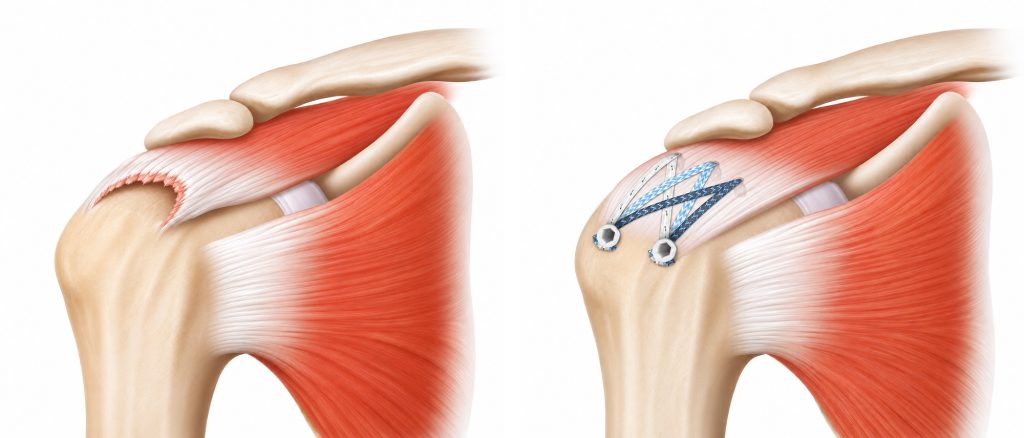
The four rotator cuff tendons lift and turn the arm. Rotator cuff injuries range from irritated tendons to tears from a single injury or from wear over time, and many partial tears improve with physical therapy. When a full tear causes pain and weakness in daily activities, or occurs in a younger, active patient, Dr. Chahla repairs the tendon arthroscopically with small anchors. He has written on biologic ways to help the repair heal [3].
Labral and biceps problems
A SLAP tear is a tear at the top of the labrum, the ring of cartilage around the socket, where the biceps tendon attaches. It is common in throwing athletes, and many improve with physical therapy; when pain or instability persists, Dr. Chahla repairs it arthroscopically. The biceps tendon itself can also become inflamed (biceps tendinitis).
AC joint injuries
The acromioclavicular (AC) joint, where the collarbone meets the shoulder blade, is often hurt in falls and contact sports. An AC joint injury, or shoulder separation, is usually treated without surgery, and wear over time can cause AC joint arthritis. Severe separations that need reconstruction are coordinated with the shoulder service.
Stiffness and arthritis
Frozen shoulder and shoulder arthritis cause pain and loss of range of motion, and most frozen shoulders improve with physical therapy and time. Shoulder avascular necrosis, a loss of blood supply to the ball of the joint, is evaluated with an MRI. When a shoulder replacement, including a reverse shoulder replacement, is the best option, Dr. Chahla refers patients to the orthopedic surgeons of the Midwest Orthopaedics at Rush shoulder service.
Where surgery takes place
Most shoulder operations Dr. Chahla performs are same day shoulder arthroscopy, done mainly at surgery centers in Chicago’s Gold Coast, Oak Brook and Oswego, and sometimes at a Rush hospital.
Dr. Chahla’s approach
Jorge Chahla, MD, PhD, is an associate professor of orthopedic surgery at Rush University Medical Center and is board certified in orthopaedic surgery and sports medicine. He completed fellowship training at the Steadman Philippon Research Institute, the Cedars-Sinai Kerlan-Jobe Institute and Midwest Orthopaedics at Rush, and is a team physician for the Chicago Bulls, the Chicago White Sox, US Soccer and the Joffrey Ballet. His shoulder surgery focuses on arthroscopic stabilization, rotator cuff repair and SLAP repair, and his research covers shoulder instability with bone loss [1][2][4] and rotator cuff healing [3].
Frequently asked questions
No. Many first time dislocations are treated with a sling and physical therapy. Surgery becomes part of the treatment plan when the shoulder keeps dislocating, when imaging shows significant bone loss, or for young athletes at high risk of another dislocation.
With a 3D CT scan, the most accurate method [1]. The amount of missing bone decides between a soft tissue repair and a bone graft.
Request an evaluation
Dr. Chahla is a shoulder surgeon in Chicago and sees patients in English and Spanish. Call (312) 432-2531, request an appointment online or email chahlapractice@rushortho.com.
- Chicago: 1611 W. Harrison St., Suite 400, Chicago, IL 60612
- Oak Brook: 2011 York Road, Oak Brook, IL 60523
- Naperville: 55 Shuman Blvd., Suite 700, Naperville, IL 60563
Atención en español. El Dr. Chahla atiende a sus pacientes en español. Llame al (312) 432-2531.
References
- Rossi LA, Frank RM, Wilke D, et al. (Chahla J). Evaluation and management of glenohumeral instability with associated bone loss: an expert consensus statement using the modified Delphi technique. Arthroscopy. 2021;37(6):1719-1728. pubmed.ncbi.nlm.nih.gov/33453347
- Gilat R, Wong SE, Lavoie-Gagne O, et al. (Chahla J). Outcomes are comparable using free bone block autografts versus allografts for the management of anterior shoulder instability with glenoid bone loss: a systematic review and meta-analysis of “The Non-Latarjet”. Knee Surg Sports Traumatol Arthrosc. 2021;29(7):2159-2174. pubmed.ncbi.nlm.nih.gov/32749510
- Mirzayan R, Weber AE, Petrigliano FA, Chahla J. Rationale for biologic augmentation of rotator cuff repairs. J Am Acad Orthop Surg. 2019;27(13):468-478. pubmed.ncbi.nlm.nih.gov/31232792
- Jackson GR, Brusalis CM, Schundler SF, et al. (Chahla J, Verma NN). Isolated primary Latarjet procedures for anterior shoulder instability results in high rates of graft resorption and glenohumeral degenerative changes with low rates of failure at a minimum 2-year follow-up: a systematic review. Arthroscopy. 2024;40(2):581-591. pubmed.ncbi.nlm.nih.gov/37270111
Medically reviewed by Jorge Chahla, MD, PhD. Last reviewed: November 22, 2026.