
Most Common Sports Injuries
What are the most common sports injuries a sports medicine surgeon treats? Five that Dr. Jorge Chahla, a sports medicine surgeon at Midwest Orthopaedics at Rush in Chicago, sees often are an ACL tear, a meniscus tear with an ACL tear, a kneecap dislocation, cartilage damage and hip impingement with a labral tear. He explains each one below.
This is not an official ranking. General lists of common sports injuries, such as the one from MedlinePlus, usually start with sprains and strains. More sourced figures are on the sports injury statistics page.
1. ACL tear: how does it happen, and how can it be prevented?
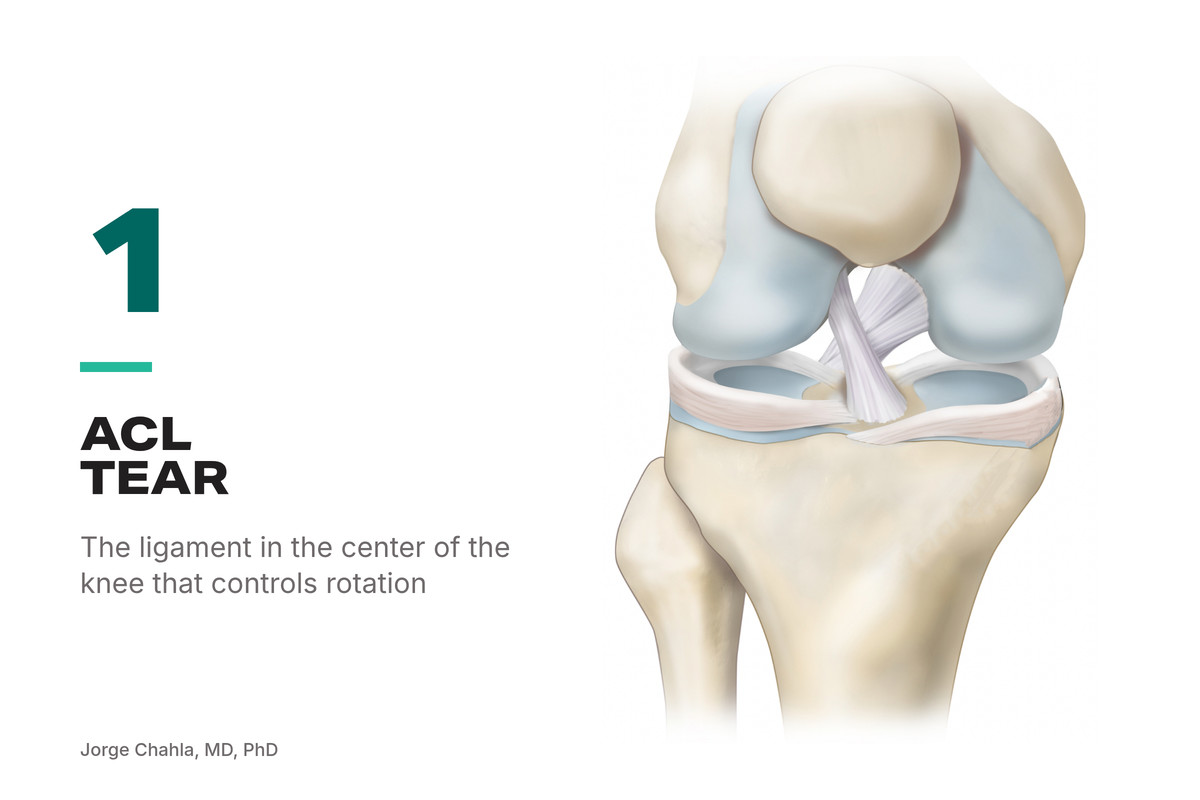
Most ACL tears happen without contact, when the knee caves inward and twists while landing or cutting.
“The ACL is the ligament in the center of the knee that controls rotation,” Dr. Chahla explains. “It almost always tears the same way, with the knee caving inward and twisting, and usually nobody even touches the athlete. That matters because a knee that is not stable keeps getting hurt, and the meniscus and cartilage are next.”
How can athletes avoid common sports injuries like this one? “The good news is that prevention works: programs that teach athletes how to land and cut reduce ACL injuries by half, and noncontact tears in female athletes by two thirds,” he says. The figures come from an analysis of eight meta analyses, most in female athletes (Webster and Hewett, 2018), and are on the sports injury statistics page.
For cutting sports, he notes, “the usual answer is a reconstruction.” Read more about ACL injuries and ACL reconstruction.
2. Torn ACL and meniscus: why do they tear together?
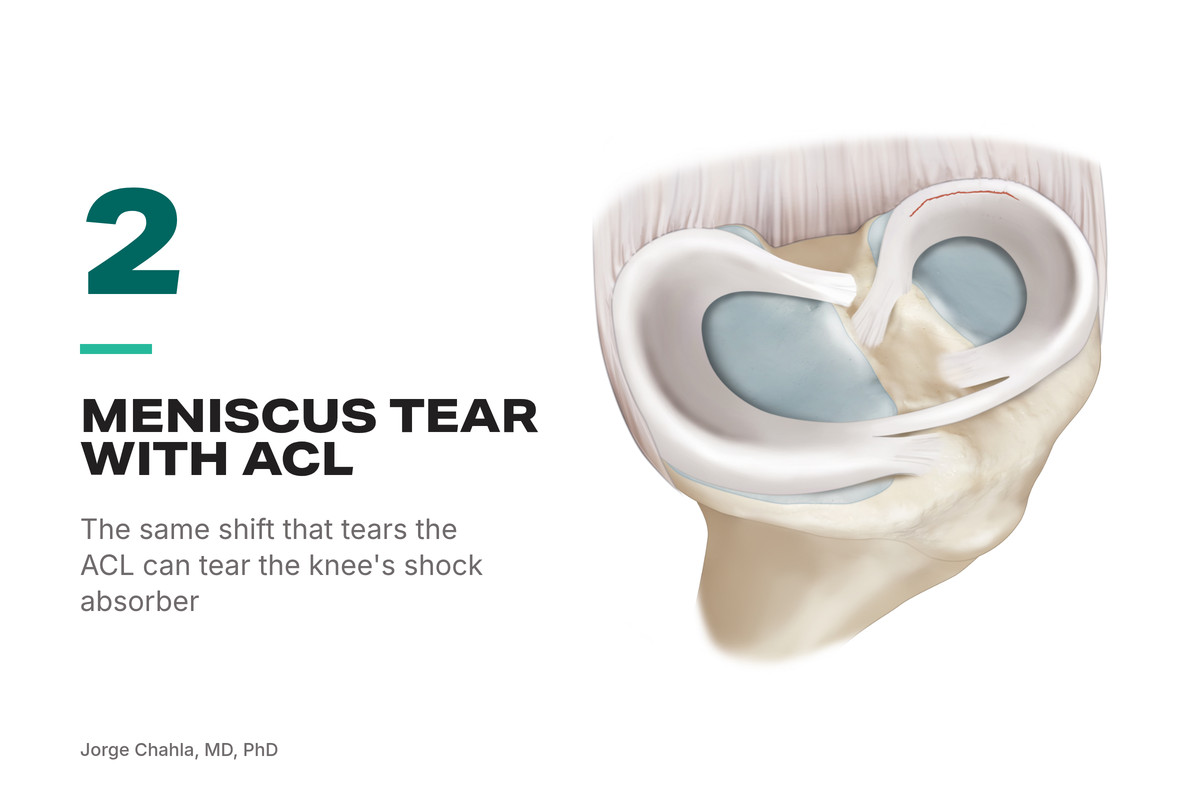
An ACL tear and a meniscus tear often happen together because the same sudden shift of the knee can injure both.
“When the ACL tears, the knee shifts suddenly, for a split second, much further than a joint is meant to go,” Dr. Chahla explains. “We can actually see it on the MRI as matching bruises on the thigh bone and the shin bone. That same shift can tear the meniscus, the knee’s shock absorber. Meniscus damage shows up in roughly a fifth to almost two thirds of ACL injuries that need surgery, and some of those tears hide at the back of the knee, so they are easy to miss.”
A 2024 review put that range at 21% to 64% of ACL injuries treated with surgery (Feroe and colleagues, 2024). See types of meniscus tears.
“How well an ACL surgery does depends a lot on the meniscus,” he says. “When we find a major tear, we try to repair it rather than take it out, because saving the meniscus protects the knee for the long run and helps protect the new ACL too.” Learn more about meniscus injuries and meniscus repair.
3. Dislocated kneecap: how long does it take to heal, and will it happen again?
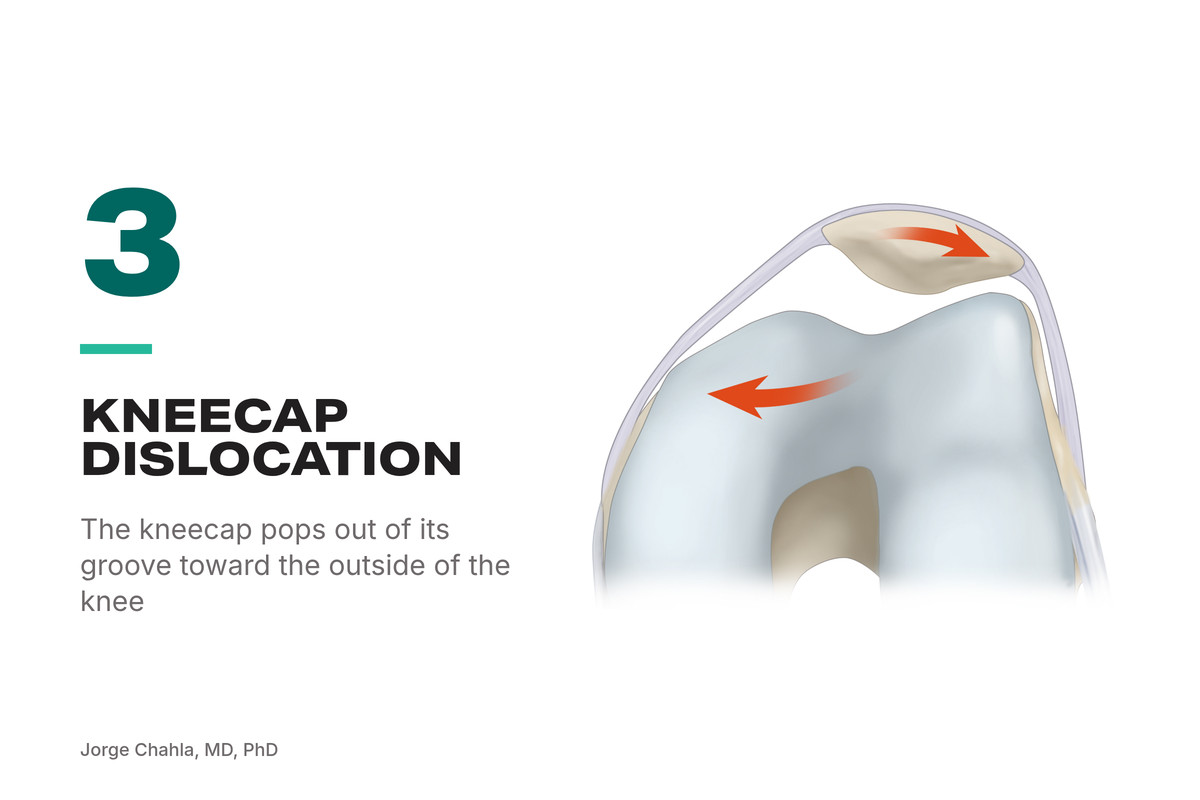
There is no single healing time for a dislocated kneecap. It depends on what was injured and on the risk of it happening again.
“When a kneecap dislocates, it pops out of its groove toward the outside of the knee,” Dr. Chahla explains. “People with a shallow groove, a kneecap that sits high, or a leg that is rotated a bit are much more prone to it, because the kneecap is not safely seated in the groove until the knee bends about thirty degrees.”
“The old teaching was that only about a quarter of people dislocate again,” he says. “It really depends on the person. In one large study, about 3 in 10 people treated without surgery had it happen again, but for people under 25 with a shallow groove the risk was 60 to 70% within five years. That is why treatment is not one size fits all.” In that study of 312 patients, 30.6% of those treated without surgery dislocated again (Lewallen and colleagues, 2015).
“If the risk is low, we usually start with physical therapy, strengthening the quadriceps, taping or a brace,” Dr. Chahla says. “If that does not work, if the risk is high, or if the dislocation knocked off a piece of cartilage, surgery makes sense.” See patellar instability and its treatment options.
4. Knee cartilage damage: does an X ray or MRI show it?
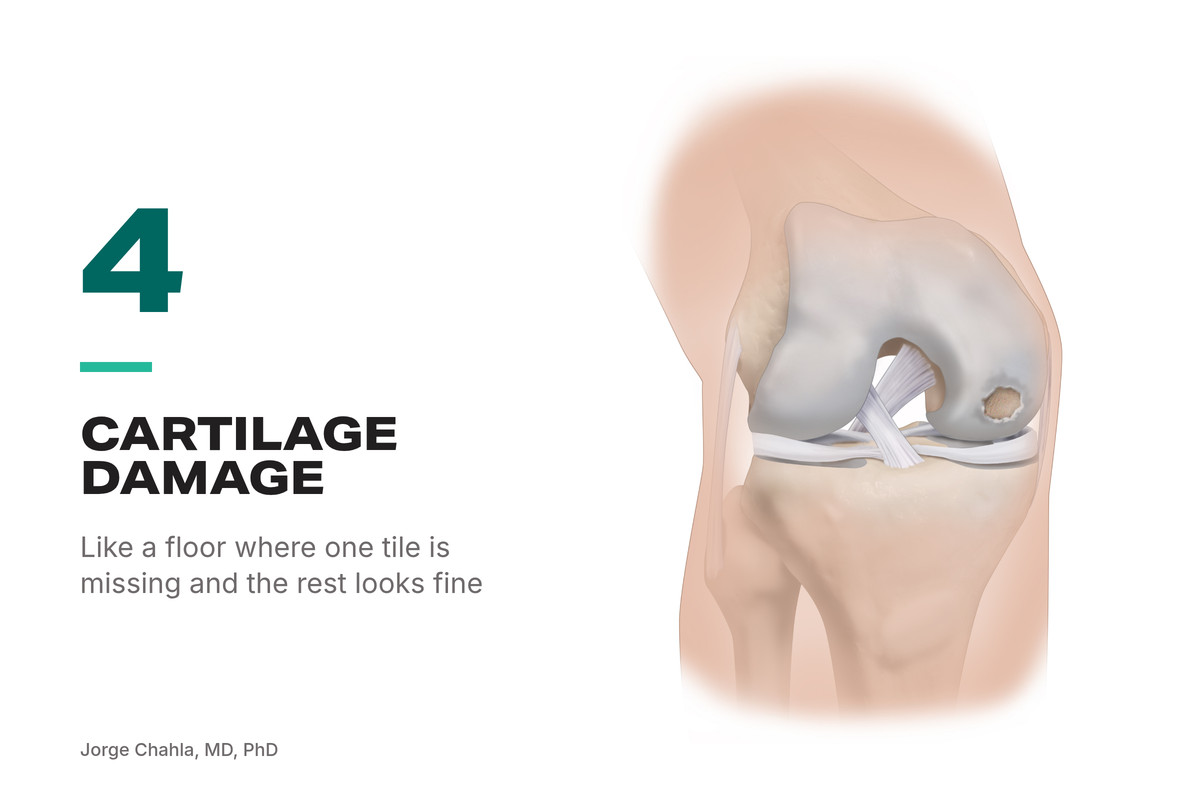
An X ray shows bone, not cartilage, so knee cartilage damage is looked for on an MRI, which can still make the damage look smaller than it is.
“Cartilage damage is one of the most common things we see, in athletes and in clinic every day,” Dr. Chahla explains. “I explain it like a floor where one tile is missing and the rest of the floor looks fine. A lot of these spots never cause symptoms. We find cartilage damage on MRIs of professional athletes all the time, and on its own it does not necessarily mean anything. It matters when that spot starts to hurt and the knee swells.”
“The MRI often makes the damage look smaller than it is,” he continues. “Looking at a broken tile from above, you see the piece that is missing, but the tiles around it can be cracked or loose, and you do not know until you step on them. In one study, the damage was bigger in surgery than on the MRI in about three out of four knees.” That study followed 77 patients who had knee arthroscopy for high grade cartilage damage: the MRI underestimated defect size, and 74% of the 92 defects were larger at surgery, measured after the damaged edges were trimmed, than the MRI estimate (Campbell and colleagues, 2013).
“Injections can help pain and function, but none of them has been shown to rebuild cartilage,” he says. Read more about knee cartilage injuries, nonsurgical treatment and surgical treatment.
5. What causes hip impingement, and how does it tear the labrum?
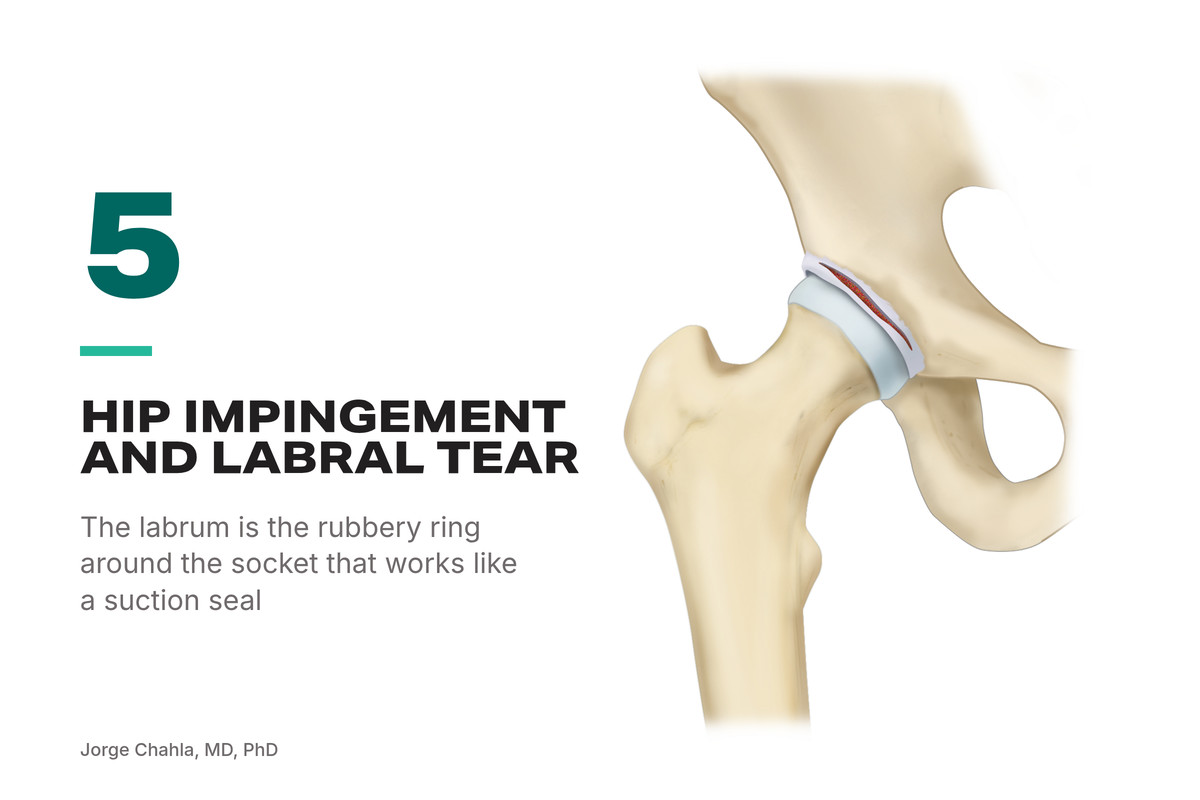
Hip impingement comes from a ball and socket that do not fit well, a cam or a pincer shape. The bones pinch, and over time that can damage the labrum.
“Hip impingement means the ball and the socket do not fit together well,” Dr. Chahla explains. “There is an extra bump of bone on the ball, called a cam, or the socket covers too much, called a pincer, so the bones hit each other when the hip bends deeply and turns in. Over time that pinching can damage the cartilage and the labrum, the rubbery ring around the socket that works like a suction seal and keeps the joint stable.”
“This shape is very common, even in people with no pain at all, and especially in athletes,” he says. “When it does cause trouble, the pain is usually deep in the groin. People notice it sitting for a long time, getting out of a car, climbing high steps, or doing squats, lunges or yoga.” A review of 2,114 hips without symptoms found a cam shape in 54.8% of athletes (Frank and colleagues, 2015).
“We start without surgery: physical therapy, core and pelvic floor work, and sometimes an injection,” Dr. Chahla says. “If that fails, arthroscopic surgery reshapes the bone so it stops pinching, repairs the labrum with anchors made entirely of suture, with no metal or plastic, and then tightens the joint lining we opened. I compare it to going from an extra large shirt to a medium after losing weight. In our practice, most athletes are back to their sport at around four to seven months.” Recovery varies from person to person. Learn more about femoroacetabular impingement (FAI), hip care and hip labral injuries.
Frequently asked questions
What are the most common sports injuries?
General lists start with sprains and strains. Five of the most common injuries a sports medicine surgeon sees are ACL tears, meniscus tears with an ACL tear, kneecap dislocation, cartilage damage and hip impingement with a labral tear.
What is the most common sports injury?
There is no single answer, and this article does not rank one first. Among knee injuries that bring athletes to a sports medicine surgeon, the ACL tear is one of the most common.
What are the top 10 most common sports injuries?
Top 10 lists usually add ankle sprains, muscle strains and concussions. This article is not a top 10 list. It explains five injuries in depth.
How can you avoid common sports injuries?
For the ACL, training that teaches athletes how to land and cut lowers the risk. See the ACL section and the sports injury statistics page.
Does an X ray show cartilage damage in the knee?
Not well. An X ray shows bone, so an MRI is used, and even an MRI can underestimate the damage.
About Dr. Chahla
Dr. Jorge Chahla, MD, PhD, is board certified in orthopaedic surgery and sports medicine. He treats knee, shoulder and hip sports injuries at Midwest Orthopaedics at Rush in Chicago, Oak Brook and Naperville, in English and Spanish. To request an appointment, call (312) 432-2531. Reporters can find interview details on the media page.
Industry relationships: Dr. Chahla is a consultant for Smith and Nephew.
Written and reviewed by Jorge Chahla, MD, PhD. Last reviewed: [APPROVAL DATE]. This article is for education and is not medical advice.
References
- Webster KE, Hewett TE. Meta-analysis of meta analyses of anterior cruciate ligament injury reduction training programs. J Orthop Res. 2018;36(10). PMID 29737024
- Feroe AG, Clark SC, Hevesi M, et al. Management of meniscus pathology with concomitant anterior cruciate ligament injury. Curr Rev Musculoskelet Med. 2024;17(8). PMID 38822979
- Lewallen L, McIntosh A, Dahm D. First-time patellofemoral dislocation: risk factors for recurrent instability. J Knee Surg. 2015;28(4). PMID 25633361
- Campbell AB, Knopp MV, Kolovich GP, et al. Preoperative MRI underestimates articular cartilage defect size compared with findings at arthroscopic knee surgery. Am J Sports Med. 2013;41(3). PMID 23324431
- Frank JM, Harris JD, Erickson BJ, et al. Prevalence of femoroacetabular impingement imaging findings in asymptomatic volunteers: a systematic review. Arthroscopy. 2015;31(6). PMID 25636988