
Lachman Test: How It Is Performed and What It Means
The Lachman Test for ACL Injury
The Lachman test is one of the most accurate physical examination tests to detect a torn anterior cruciate ligament. It is more reliable than the anterior drawer test and more comfortable for an acutely injured patient, and for those reasons it is the test Dr. Jorge Chahla performs first when an ACL injury is suspected.
Dr. Chahla is a knee surgeon at Midwest Orthopaedics at Rush and Associate Professor of Orthopedic Surgery at Rush University Medical Center, where he directs Biomechanical Research and the International Fellowship Program.
What is the Lachman test?
The Lachman test assesses anterior translation of the tibia (shinbone) relative to the femur (thigh bone) with the knee flexed to about 20 to 30 degrees. It tests the ACL near extension, where the posterolateral bundle contributes most of the restraint, and it detects both how far the tibia moves forward and, more importantly, whether that movement comes to a firm stop.
The test was described by Joseph Torg in 1976 and named after his mentor, John Lachman, and it has remained the reference physical examination test for ACL integrity for five decades.
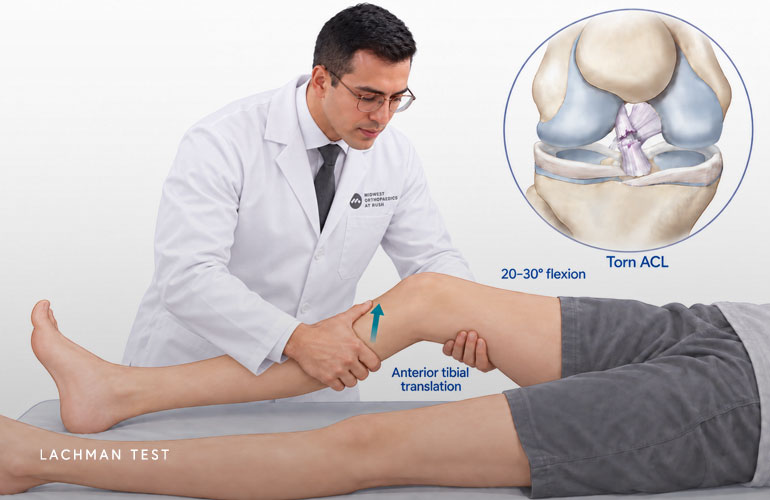
How the Lachman test is performed
The patient lies supine with the leg relaxed, which is the part of the test that most often fails, because a guarded hamstring can mask a completely torn ACL.
The examiner flexes the knee to 20 to 30 degrees, stabilizes the femur with one hand placed just above the knee, and grasps the proximal tibia with the other hand with the thumb over the joint line. An anteriorly directed force is then applied to the tibia while the femur is held still.
The examiner assesses two things at once: how far the tibia translates forward compared with the opposite knee, and the quality of the endpoint at which that translation stops.
What is a positive Lachman test?
A positive Lachman test shows increased anterior translation compared with the uninjured knee, together with a soft or absent endpoint. The endpoint matters more than the distance. A knee that translates a long way but stops firmly may simply have physiologic laxity, whereas a knee that translates a modest amount and then keeps going has a torn ACL.
Results are graded by the amount of increased translation relative to the other side: grade 1 for 1 to 5 millimeters, grade 2 for 6 to 10 millimeters, and grade 3 for more than 10 millimeters. Each grade is further described as having a firm or a soft endpoint.
A positive Lachman test in a patient with a clear injury mechanism and an effusion is close to diagnostic. It does not remove the need for an MRI, because the MRI defines the associated meniscal, cartilage and collateral injuries that determine what the operation will actually involve.
Lachman test vs anterior drawer test
Both assess anterior tibial translation, but the Lachman test is superior for three reasons.
At 20 to 30 degrees of flexion, the position of the Lachman test, the posterior horn of the medial meniscus does not act as a wedge blocking anterior translation, whereas at the 90 degrees required for the anterior drawer test it can, producing a false negative.
The Lachman position also relaxes the hamstrings, while the flexed position of the anterior drawer test recruits them, and a contracted hamstring restrains the tibia and masks laxity.
Finally, an acutely injured knee frequently cannot be flexed to 90 degrees at all, which makes the anterior drawer test impossible in exactly the situation where the diagnosis is most needed.
Reported sensitivity for the Lachman test is 85 to 95 percent, compared with roughly 55 to 75 percent for the anterior drawer test.
What are the other tests for a torn ACL?
Searches for tests for torn ACL turn up three names, and they are complementary rather than interchangeable.
The Lachman test is the primary test and the most sensitive. The anterior drawer test assesses the same translation at 90 degrees of flexion and is less accurate, but it is performed in the same position as the posterior drawer test and is therefore efficient when both cruciate ligaments need assessment.
The pivot shift test assesses rotational instability rather than straight-line translation. The knee is taken from extension into flexion while a valgus and internal rotation force is applied, and in an ACL-deficient knee the lateral tibial plateau subluxes forward and then reduces with a palpable clunk. It is the test that correlates best with the functional instability patients actually describe, and a knee with a positive pivot shift under anesthesia has a significant ACL injury regardless of how the Lachman felt in clinic. It is also the least tolerated of the three in an awake, acutely injured patient, which is why it is often deferred.
No physical examination test replaces the MRI, and the MRI does not replace the examination. The examination establishes whether the knee is unstable. The MRI establishes what else is torn.
Why the test can be falsely negative
Three situations produce a falsely reassuring Lachman test. A guarding patient who will not relax the hamstrings is the most common. A large-thighed patient whom the examiner cannot grasp adequately is the second. A displaced bucket-handle meniscal tear that mechanically blocks translation is the third and the most important, because it is the situation in which the knee has two injuries, and the ACL tear is easily missed.
Frequently asked questions
Is the Lachman test painful?
It should not be. It is performed with the knee only slightly flexed and requires very little force, which is why it is tolerated far better than the anterior drawer test in an acutely injured knee.
Can the Lachman test be negative with a torn ACL?
Yes, most often because the patient is guarding, because the examiner cannot control the limb adequately, or because a displaced meniscal fragment is blocking translation. A convincing history with an effusion warrants further assessment even after a negative test.
Does a positive Lachman test mean surgery is needed?
No. It means the ACL is torn or attenuated. Whether reconstruction is recommended depends on the patient’s activity demands, whether the knee gives way in daily life, and what else is injured.
What is a grade 3 Lachman test?
More than 10 millimeters of increased anterior translation compared with the other knee, usually with a soft endpoint, indicating a complete ACL tear.
Can you test for a torn ACL at home?
Not reliably. The test depends on controlling the limb, on the patient relaxing completely, and on comparing directly with the other knee, and an inexpert attempt most often produces a falsely negative result. A knee that swelled within a few hours of a twisting injury should be examined regardless of what any self-test suggests.
Who should perform the Lachman test?
Anyone trained to do so, but the accuracy figures quoted above come from experienced examiners. The test is technique-dependent, and an inconclusive test in inexperienced hands should not be treated as a negative one.
If you have injured your knee and are concerned about an ACL tear, you can request an appointment with Dr. Chahla at Midwest Orthopaedics at Rush for a full examination.